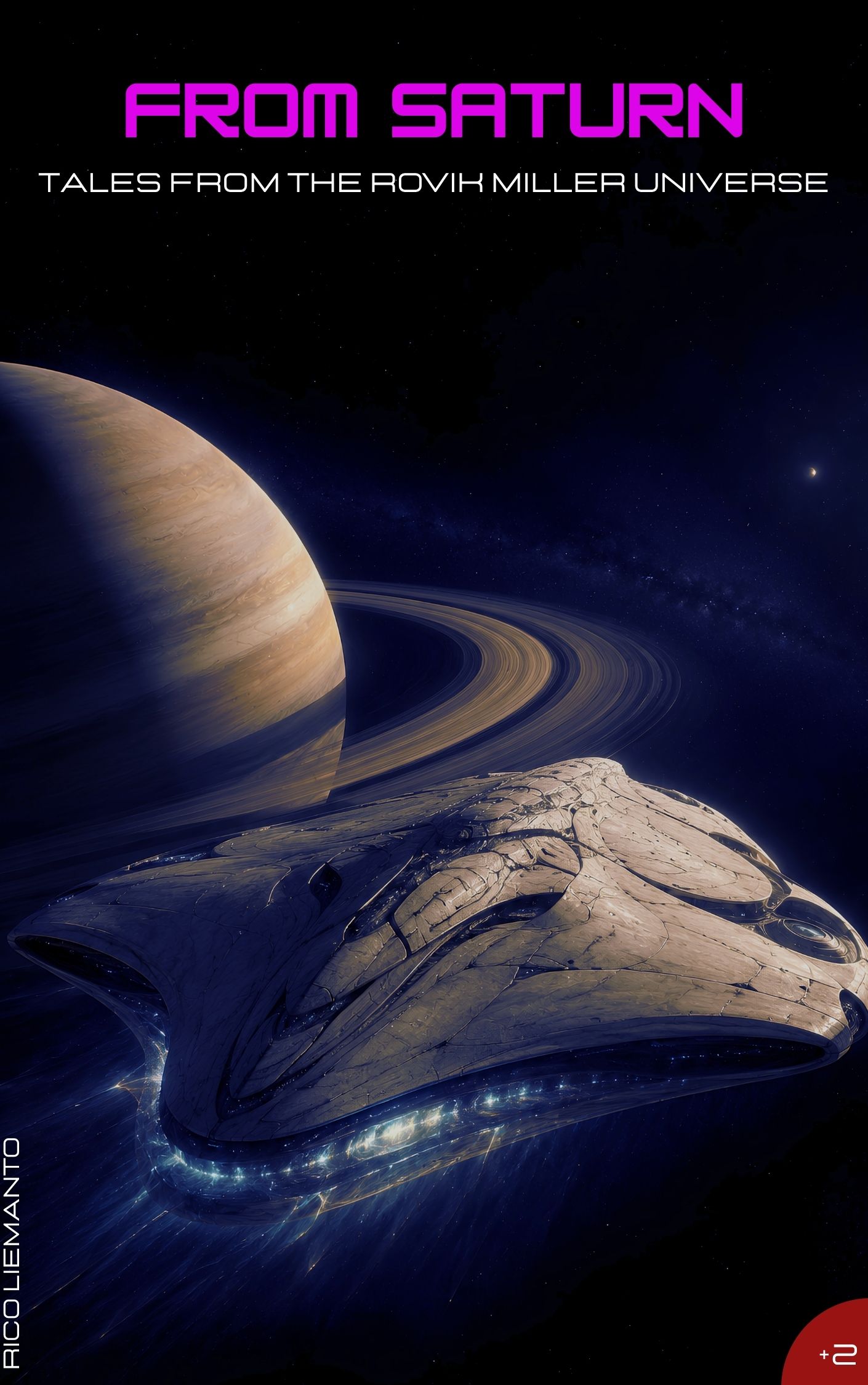
INTERSYSTEM VEHICLE
Old Varn remained in the engine room long after the others were gone.
For a while, he did nothing.
He stood where Rovik, Kblekt, and the Sheriff had left him, surrounded by machinery that should not have existed anywhere on OES, and listened to the fading echo of their footsteps disappearing through the corridors. Eventually even that vanished. The only sounds left were the slow turning of damaged mechanisms, the hiss of pressure escaping somewhere high above him, and the deep mechanical hum that seemed to come from every wall at once.
Deyric's body lay several meters away.
Old Varn looked at it once, then at the enormous machine surrounding them both.
"Should've just asked," he muttered.
Then he went to work.
He started with the bodies.
Not because he cared much about cleanliness, and certainly not because he had any affection left for the aliens that had dragged him out of Marrowick and beaten him bloody when he refused to cooperate. He simply did not work well with corpses underfoot.
Deyric was heavier than he looked. The dark suit wrapped around his narrow body resisted being dragged, catching against the grated floor until Old Varn finally grabbed him beneath the arms and hauled him toward the nearest corridor. The other bodies took longer. He moved them all into one of the unused crew rooms he had passed earlier, placing them on the simple bunks fixed along the curved walls. Whatever else they had done, this had been their vessel, and he saw no reason to leave them scattered across it like discarded parts.
Afterward, he returned to the engine room and stood beneath the largest rotating assembly.
His swollen eye had nearly closed. His ribs hurt whenever he breathed too deeply. Blood had dried stiff beneath his shirt. A reasonable man would have rested.
Old Varn had never been particularly interested in being reasonable.
He tilted his head back.
The engine room was enormous. Even after everything he had already seen, its scale still bothered his sense of proportion. Pipes thicker than his torso ran along the walls before disappearing into sections of smooth metal that revealed no obvious access panels. Vents opened and closed in slow cycles, releasing short breaths of vapor. Thick cables could be seen beneath the grated flooring, bundled together in black runs that branched in directions he could only guess at. On either side of the chamber, huge mechanical structures rotated around faintly illuminated inner sections, each turn producing a vibration he could feel through the soles of his boots.
Nothing about it was decorative.
This machine did not care whether anyone thought it was pretty. That pleased him.
It had pipes because it needed pipes. Cables because something needed power. Vents because something needed cooling or pressure relief. The mechanisms turned because their movement mattered to something else.
Old Varn smiled.
"Alright," he said quietly. "Let's see what you are."
He spent the first several days learning how not to break it worse.
That was harder than it sounded.
The ship did not obey any mechanical language he knew, but it was not incomprehensible either. The first mistake he made taught him that much.
A thick cable beneath the eastern section of the engine-room grating disappeared into a damaged junction near one of the rotating assemblies. The connection had partially torn free during the crash, leaving the cable twisted at an angle that would have made any OES power conduit useless. Old Varn spent almost an hour freeing the damaged coupling. He expected the mechanism beside him to stop when he disconnected it.
Instead, every light in the corridor outside went dark.
He froze.
The rotating mechanism continued turning.
Old Varn slowly looked toward the doorway.
"Well."
He reconnected the cable.
The corridor lights returned one by one.
He stared at the cable for several seconds, then scratched a note into a sheet of metal he had dragged into the room.
NOT ENGINE.
After a moment he added:
LIGHTS. MAYBE.
That became his method.
He had no manuals he could read, no schematics he understood, and nobody left alive to explain anything. So he disturbed one thing at a time and watched what happened.
A narrow pipe running beneath the western wall turned out not to be carrying liquid at all. Disconnecting it caused three vents near the ceiling to slam shut and one damaged monitor halfway across the ship to begin screaming symbols at him.
A flat component buried behind an access plate looked like a regulator. It was not. Removing it shut down two automatic doors and somehow made one of the crew-room lights brighter.
He put it back.
A cracked circular assembly beside the main engine feed responded whenever he struck the housing with the handle of his wrench.
That one he understood immediately.
"Now you're speaking my language."
He struck it again.
The hum deepened.
Old Varn grinned.
Some things, apparently, were universal.
He slept wherever he became too tired to stand. Sometimes that meant one of the abandoned bunks. More often it meant the engine-room floor with his jacket rolled beneath his head and a toolbox close enough to reach without getting up.
For food, he just goes Outside and hunt something to eat. And being an Orc, he doesn’t really need that much to drink.
Time became something he measured in repairs.
One vent working.
Two doors restored.
One lighting circuit stabilized.
A damaged section isolated.
A pressure line returned to function.
He learned the ship through consequences.
A particular hiss from the vents meant pressure had returned to the upper circulation system. A vibration that started beneath the central grating and spread outward meant power was transferring through the lower assemblies. When one of the rotating mechanisms began making a faint clicking noise every eighth revolution, he knew something had slipped long before he found the damaged support deeper inside its housing.
That repair took nearly two days.
The original support was made from a material he could not cut with anything he owned. His torch barely marked it. He eventually abandoned the idea of replacing it and instead built a brace around it from salvaged OES steel, using the brace only to keep the alien component aligned while the original mechanism carried the actual load.
Ugly.
Temporary.
Effective.
Old Varn approved.
The ship slowly began changing around him.
Not physically. It remained the same cold wreck it had been when Rovik first entered it. The walls still curved at angles that made some corridors feel slightly wrong. The metal remained dark and scarred. Entire sections were still without power. Overhead lights continued to flicker in places, and several doors stayed permanently open because their motors had burned out years ago.
But more of it worked.
A corridor that had been black for years suddenly held steady light.
A dead screen came alive when he rerouted power from an unused crew section.
The automatic door leading into the engine room stopped catching halfway and began opening cleanly whenever he approached.
The low hum beneath the floor became stronger.
Eventually Old Varn stopped thinking of those sounds as strange.
He knew them.
That was different.
The control room took longer.
Old Varn had avoided it at first because he had no use for controls when the machine itself could barely stay alive. Once the engine systems became stable enough to run for several hours without something failing, he finally carried his tools up through the winding corridors and returned to the chamber.
Most of the monitors were still dead.
Some had cracked during the crash. Others lit only along one edge, filling with meaningless bands of color whenever power reached them. Several consoles were missing buttons entirely. One section of the wall had buckled inward hard enough to tear three control stations away from their mounts.
The solar-system display still worked.
Barely.
Old Varn stood in front of it with both hands on his hips.
Earth was easy enough to recognize.
So was the Moon.
Farther outward sat the enormous ringed planet he already knew from old diagrams and half-remembered lessons. Saturn. Near it, the same point Rovik had mentioned continued to pulse at regular intervals.
He turned toward the consoles.
The real problem was the language.
There were symbols everywhere. Some appeared to be words. Others seemed to represent numbers, system states, directions, or warnings. Old Varn had already learned a few through repetition. One symbol appeared every time a system lost power. Another showed itself whenever pressure dropped. A third seemed related to doors.
That was not enough to fly anything.
Deyric had spoken the same language as everyone in Marrowick, though. Not perfectly, but well enough. Which meant somewhere aboard the ship there had to be a way to translate.
Old Varn began looking.
It took him nearly a week.
He eventually found what he thought was the translation system by accident while trying to restore a bank of damaged monitors along the rear wall. Behind one console sat a series of small physical modules connected to a larger processing assembly. Most were intact. One had been shaken loose.
Old Varn reseated it.
The console restarted.
Symbols flooded across the monitor.
He sighed.
Then the symbols changed.
Not all of them.
One line near the bottom remained alien. Another became nonsense. But the largest heading transformed into letters he could read.
ENVIRONMENTAL CONTROL.
Old Varn stared.
Then he sat down.
"Huh."
He pressed the same control again.
The screen shifted.
AIR CIRCULATION.
PRESSURE.
TEMPERATURE.
Three more words beneath them failed to translate at all.
Old Varn leaned closer, suddenly much more awake.
It was not magic. It was not the ship recognizing him. There was no voice waiting to answer questions. The translation system had simply been damaged like everything else, and one of the modules he had restored allowed part of it to function again.
That was enough.
Over the following days he repaired everything he could around that console and began working through the other control stations.
The translations were terrible.
Sometimes a word changed meaning between screens. Sometimes entire sections remained unreadable. One navigation entry translated the same symbol as ARRIVAL, IMPACT, and MEETING depending on which monitor displayed it.
Old Varn learned to stop trusting individual words.
Patterns mattered more.
They always did.
He began with system information because that was the easiest to confirm physically. If a screen said COOLING and activating the corresponding switch opened vents in the engine room, he trusted it. If a control marked AUXILIARY LIGHTS caused a door to lock instead, he wrote the translation off as wrong.
Bit by bit, the ship built its own dictionary for him.
And eventually, its records started opening.
Old Varn expected technical logs.
He found those.
Most were useless. Numbers without units. Diagrams without labels. Damage reports translated into sentences that barely resembled language.
Then he found personnel records.
There were only fragments left.
Several names.
Several images.
Most of the crew had been marked with a symbol the translator eventually rendered as DECEASED.
Old Varn scrolled until he found a familiar face.
Deyric did not look human in the image.
His real face stared back from the screen, pale green and angular, with the same stretched proportions Old Varn remembered seeing beneath the false body.
The text beside it took several attempts to stabilize.
DEYRIC.
SATURNIAN.
TROOPER.
EMISSARY ASSIGNMENT.
Old Varn leaned back.
"So you weren't lying."
Another record placed Deyric's origin beside the ringed planet on the navigation display.
SATURN.
Old Varn rubbed his beard.
An alien from Saturn had kidnapped him.
That was going to take some getting used to.
He kept reading.
The craft's own identification record took longer to recover. Most of the header had been corrupted, but eventually the translator stabilized enough to produce two words.
INTERSYSTEM VEHICLE.
Old Varn read them twice.
Then a third time.
"That's your name, then?"
He frowned at himself.
"No. Classification."
He reached for the metal sheet where he had been keeping his notes and wrote it across the top in large letters.
INTERSYSTEM VEHICLE.
No model.
No serial information he could understand.
Just that.
It suited the machine well enough.
He continued through Deyric's records.
The more Old Varn read, the stranger Deyric became.
Not crueler.
Stranger.
There were communications preserved in damaged fragments. Orders. Reports. Crew statements. Procedures. Old Varn read through dozens before something began bothering him.
Nobody asked anything.
Not once.
There were requests in the sense that one person needed something from another, but even those were written as declarations.
ASSISTANCE REQUIRED.
COURSE CORRECTION NECESSARY.
MEDICAL ATTENTION REQUIRED.
ACCESS WILL BE PROVIDED.
MECHANIC REQUIRED.
The language kept repeating.
No may.
No can.
No would.
No please.
Old Varn thought about the night in Marrowick.
Deyric sitting across from him.
Deyric watching his hands.
Deyric asking about machines in that strange, careful way of his.
Then the fight.
The pain.
The sudden disappearance from the saloon.
Old Varn found another record.
LOCAL TECHNICAL PERSONNEL ASSESSED.
INSUFFICIENT.
SEARCH CONTINUES.
The next entries were spread across years.
Settlement names, some translated incorrectly. Notes about machines. Workshops. People.
Then:
TECHNICAL SUBJECT IDENTIFIED.
VARN.
COMPETENCY EXCEEDS REQUIREMENT.
ACQUISITION COMPLETE.
Old Varn stared at the words.
He sat there for a very long time.
Then he started laughing.
It came slowly at first, one rough chuckle that escaped before he could stop it. Then another followed. Soon he was leaning against the console, shoulders shaking, laughter echoing through the damaged control room.
"Acquisition?"
He slapped the console once.
"You stupid bastard."
Old Varn wiped one eye with the back of his hand.
Deyric had spent years wandering across OES looking for a mechanic. Years. The original mechanic aboard the INTERSYSTEM VEHICLE had died in the crash, leaving the surviving crew unable to repair the vessel. Deyric had checked one settlement after another until he finally reached Marrowick and found Old Varn.
And then he kidnapped him.
Old Varn leaned back in the chair and imagined the alternative.
Deyric walking into his garage.
Standing there in that fake human body.
Saying, I have a broken spacecraft from Saturn.
Old Varn would probably have dropped whatever tool was in his hand and left before the alien finished the sentence.
"Could've just asked," he said again, still laughing.
The ship hummed around him.
It did not answer.
That was probably for the best.
The mission record appeared three days later.
By then Old Varn had restored enough of the control network that navigation data could be accessed from more than one console. The solar-system display no longer faded every few minutes, and the pulsing point near Saturn had resolved into several layers of information he still could not understand.
One section, however, opened into what appeared to be the vessel's original route.
Saturn.
A line through the system.
Moon.
Old Varn leaned closer.
"So that's where you were going."
He opened the attached mission file.
Most of it was destroyed.
Whole portions had become blocks of corrupted symbols. Several entries refused to open. One displayed nothing but static. Another produced a sequence of untranslated characters that vanished before he could copy them.
Then one line stabilized.
DELIVER THESE WEAPONS INTO THE MOON.
Old Varn frowned.
He waited for more.
Nothing came.
He checked the adjacent files. Corrupted.
Tried another console. Same result.
Returned to the mission record and read the line again.
Deliver these weapons into the Moon.
"These weapons?"
That sent him looking.
The ship was far larger than anything he had ever encountered. He had spent weeks crawling through maintenance spaces and power routes that seemed to extend endlessly through the flattened hull.
But now he had a reason to go deeper.
He followed cargo references through the damaged control network until he identified a section several levels beneath the main control room. Reaching it required restoring power to two separate corridors and manually forcing a third door open after its automatic mechanism refused to respond.
The deeper sections were darker.
Colder too.
His lamp moved across the same smooth metal walls he had come to know, interrupted occasionally by broken screens or faded markings. The corridors bent at angles that would have made no sense in an OES building, narrowing unexpectedly before opening again into junctions with doors set into curved walls.
Some doors opened automatically as he approached.
Others remained dead.
One opened halfway and stopped.
Old Varn squeezed through sideways.
"Still hate you," he muttered.
The corridor beyond led to a reinforced door unlike anything else aboard the ship.
It was not elegant.
That was what bothered him.
Most doors aboard the INTERSYSTEM VEHICLE disappeared into the walls with almost no visible mechanism. This one had physical locking structures around its frame. Thick mechanical housings. Multiple reinforced points. A console mounted beside it displayed the same warning symbol again and again.
Old Varn had learned that symbol early.
DANGER.
Another appeared beneath it.
AUTHORIZED.
A third refused to translate.
He considered going back.
Then he noticed that the locking system was already partially disengaged.
Curiosity won.
It usually did.
Old Varn spent an hour restoring power to the remaining locks. Not because he needed them open, but because if he discovered something dangerous behind the door, he wanted to know he could close it again.
When the final mechanism released, the locks withdrew one after another with heavy metallic impacts that carried down the corridor.
The door opened.
Old Varn stepped through.
Then stopped.
The chamber beyond was enormous.
Rows disappeared into darkness.
At first his mind tried to understand the objects as machinery. That was easier. Machinery had purposes he could uncover. Inputs. Outputs. Moving parts.
Then he recognized one shape.
A rifle.
It resembled the weapons Deyric's surviving people had carried. Smooth construction. Almost no visible seams. A long sealed body with unfamiliar mechanisms and a series of energy coils running along one side.
There were hundreds.
Maybe thousands.
Old Varn moved his lamp farther across the chamber.
Larger weapons sat behind them.
Some were mounted inside heavy frames secured directly to the floor. Others rested within reinforced containment structures. One machine was so large that Old Varn could not imagine moving it without lifting equipment, yet the locking system around it suggested that movement had been expected.
Another weapon sat behind shielding thick enough to make him immediately uncomfortable.
He walked no closer.
Every instinct he possessed wanted to.
That was the problem.
Old Varn had built his life around taking things apart.
Give him an engine and he wanted the housing off.
Give him a gun and he wanted to know how the firing mechanism worked.
Give him something completely unknown and he generally considered that an invitation.
But engineering taught caution too.
He understood restraints.
He understood isolated power feeds.
He understood reinforced mounts designed to keep something from shifting even under catastrophic force.
He understood why a machine would have three separate locks instead of one.
And he understood warning markings.
There were more of them in this room than anywhere else aboard the ship.
Old Varn lowered his lamp.
"Nope."
He backed toward the door.
For once in his life, he did not touch anything.
Whatever Saturn considered dangerous enough to secure this carefully did not need Old Varn experimenting with it while standing alone inside a crashed ship.
He left the arsenal exactly as he found it.
Then he closed the reinforced door and watched every restored locking mechanism engage.
Only when the final lock slammed into place did he breathe easier.
Back in the control room, the mission entry still waited on the screen.
DELIVER THESE WEAPONS INTO THE MOON.
Old Varn sat in front of it.
He looked at the route.
Saturn.
Moon.
Then toward the corridor leading eventually to the arsenal.
"Why?"
The record offered nothing else.
Whoever on the Moon had been meant to receive the weapons was gone from the surviving data.
So was the reason.
There were no political records Old Varn could understand. No explanation of Saturn's relationship with the Moon. No indication whether the weapons were being sold, gifted, supplied, hidden, or prepared for something.
Just the instruction.
Deliver these weapons into the Moon.
Old Varn shut the monitor off.
Some machines told you what they were doing if you watched long enough.
People were harder.
Apparently aliens were too.
The repairs continued.
Months blurred together.
Old Varn stopped counting them.
The INTERSYSTEM VEHICLE became his entire world.
He knew which grated floor panel near the engine room had to be lifted from the left because the right-side catch had fused shut. He knew the third overhead light in the western corridor would flicker whenever the secondary power network came under load. He knew a double hiss from the large vent above the engine chamber meant pressure was stable, while a long continuous release meant he had approximately thirty seconds to shut down the adjacent transfer system before something overheated.
He learned the machine the same way he had learned every motorcycle, generator, firearm, pump, gate mechanism, and broken piece of junk that had ever entered his garage.
By living with it.
By listening.
By being wrong.
The wrong parts were important.
Once he rerouted power through what the translator called a secondary distribution network and accidentally shut down every monitor in the control room.
Another time he repaired a damaged junction expecting to restore one of the engine assemblies and instead brought power back to six crew rooms, two corridor doors, and what appeared to be a food-storage unit.
He spent nearly an entire day tracing a pipe he was convinced belonged to the cooling network only to discover it fed a pressure system controlling part of the landing mechanism.
"Who designed you?"
He lay on his back beneath the grating as he said it, one arm buried up to the shoulder inside an access space.
A vibration answered through the floor.
Old Varn frowned.
"No. That's not you talking. That's bearing four."
He climbed out and went to inspect it.
Bearing four was not actually a bearing.
But that was what he called it.
He had names for dozens of things now.
The ship had its own names, of course. The translation system occasionally provided them, usually badly. Old Varn preferred his.
The Twin Wheels were the enormous rotating assemblies on either side of the engine chamber.
The Spine was the main cable run beneath the central grating.
The Bastard was a power junction that had shocked him three times despite every reading insisting it was inactive.
The Singer was a pressure valve that produced a high metallic tone when the engine was operating correctly.
He did not pretend the machine understood any of this.
Names were for him.
They made the impossible manageable.
And slowly, the impossible became manageable.
The Twin Wheels held consistent rotation.
The Spine carried stable power without overheating.
The Singer began producing its note every time the engine reached operating pressure.
The Bastard shocked him a fourth time.
Old Varn considered removing it entirely out of spite before deciding he preferred having functioning navigation.
His own materials appeared throughout the repairs, but never where they did not belong. OES steel reinforced cracked housings. Ordinary wire held sensor bundles away from rotating components. Brackets from his tool kit kept damaged panels from shifting. A section of salvaged plating became a temporary support beneath an access platform.
He never tried replacing Saturnian components with OES junk.
There was no point pretending metal was electricity or wire was whatever passed through the alien conduits.
If an advanced component was destroyed, he scavenged another from a dead section of the ship.
That became his greatest advantage.
The crash had killed enormous portions of the INTERSYSTEM VEHICLE, but not all of them mattered anymore.
The crew quarters did not need full power.
Half the environmental systems were redundant with the others.
Entire banks of equipment belonged to functions Old Varn had no intention of using.
So he cannibalized.
One intact regulator from a dead compartment revived part of the engine network.
A control module taken from an unused station stabilized the lift system.
Two functioning couplings from somewhere near the sealed arsenal replaced shattered ones beneath the control room.
The ship grew smaller in capability and stronger in function.
Old Varn did not need everything.
He needed enough.
Enough power.
Enough cooling.
Enough control.
Enough lift.
Enough propulsion to get the machine out of the hole it had been sitting in for years.
First, he wanted to make it fly.
The first time Old Varn tested the lift system, nothing happened.
He sat alone in the control room surrounded by monitors that now glowed more steadily than they had in years. The solar-system display illuminated the chamber with a faint wash of color. Several consoles still remained dead, and one screen to his right showed nothing but corrupted symbols, but the central systems were functioning.
At least according to his notes.
Old Varn checked them again.
Engine pressure stable.
Primary power stable.
Cooling stable.
Atmospheric propulsion available.
Stabilization available.
Lift available.
He looked at the physical controls in front of him.
There were too many.
Buttons.
Switches.
Two recessed handles.
A control surface that seemed to adjust orientation.
Several systems had been identified only by watching diagrams react when he moved the controls without engaging the engine.
He knew enough.
Old Varn rested one hand on the lift control.
"Alright."
He activated it.
Nothing.
Old Varn waited.
The ship continued humming.
He pressed it again.
Still nothing.
His expression flattened.
He checked the monitor.
LIFT ACTIVE.
"No, it ain't."
He shut the system down, left the control room, walked the entire distance back to the engine chamber, and discovered the Singer had stopped.
Pressure failure.
He repaired it.
Returned to the control room.
Tried again.
Nothing.
This time a stabilization warning appeared.
Back down.
Another repair.
Back up.
Third attempt.
The lights dimmed so badly that half the room disappeared into darkness.
Old Varn swore, shut everything down, and spent the next six hours tracing the power loss.
On the fourth attempt, the INTERSYSTEM VEHICLE moved.
Barely.
A vibration passed through the hull that was different from anything Old Varn had felt before. Not engine vibration. Not pressure. The entire structure seemed to unload its own weight for half a second.
Then it dropped again.
Sand shifted somewhere outside.
Old Varn went perfectly still.
A grin spread slowly across his face.
"Again."
The fifth attempt lifted one side of the hull.
The sixth almost destroyed the stabilization system.
The seventh produced nothing because the engine overheated.
The eighth raised the whole ship by several centimeters before something underneath it gave a noise so violent that Old Varn shut the system down immediately.
He spent another two days repairing that.
By then anyone else might have reconsidered.
Old Varn became increasingly cheerful.
The machine could lift.
That changed the problem entirely.
It was no longer about whether the INTERSYSTEM VEHICLE could fly.
It was about convincing it to do so without killing him.
That was ordinary work.
The day it finally happened began without ceremony.
Old Varn woke on a crew-room bunk, ate, drank, washed the worst of the grease from his hands, and walked to the engine room.
The Singer sounded right.
The Twin Wheels maintained speed.
No abnormal vibration ran through the Spine.
He checked every major repair anyway.
Then he climbed to the control room.
Morning light reached the chamber only through the opened sections of damaged hull farther down the ship, but the monitors provided enough illumination. Old Varn lowered himself into the control seat and looked over the physical switches surrounding him.
The seat was not built for an orc his size.
That irritated him more than anything else aboard the vessel.
He adjusted himself until his knees stopped pressing against the console.
"Let's go."
He activated primary power.
The mechanical hum deepened.
One monitor after another changed status.
He opened cooling.
Vents throughout the ship began cycling.
Pressure climbed.
The engine display stabilized.
Old Varn engaged lift.
At first, nothing changed.
Then the hull groaned.
It was a deep sound, old metal resisting forces it had not felt in years. Sand slid across the exterior in long rushing sheets. Somewhere beneath the ship, buried plating tore free from the weight packed around it.
Old Varn watched the stabilization readings.
One side climbed faster than the other.
He corrected.
Too much.
The entire vessel lurched.
Old Varn slammed one hand against the console to keep himself in the seat as alarms flooded two monitors. The left side rose sharply, tilting the control room enough that a loose tool slid across the floor and struck the wall.
"Easy."
He reduced lift on that section.
The ship dropped hard.
The impact traveled through the hull.
A warning appeared.
Old Varn ignored it.
He adjusted again, smaller this time.
The INTERSYSTEM VEHICLE began to rise.
Outside, years of packed sand broke apart.
The dunes that had swallowed most of the flattened hull collapsed away from it in enormous curtains. Metal emerged from the ground inch by inch, then meter by meter: tarnished-bone plating blackened by the crash, broad curved surfaces split by deep cracks, damaged sections still flickering with faint blue light.
Inside, Old Varn could hear everything.
The engines.
The vents.
The strain in the hull.
The Twin Wheels increasing speed far below.
The Singer holding steady.
The Bastard, thankfully, doing whatever the Bastard was supposed to do.
The ship climbed another meter.
Then another.
Old Varn looked at the orientation display.
The nose was dropping.
He corrected.
Too slowly.
The INTERSYSTEM VEHICLE pitched forward, shedding another avalanche of sand as the rear lifted clear of the dunes. Old Varn pulled the control back harder than he intended.
The response was immediate.
The nose snapped upward.
His stomach dropped.
"Oh, you're sensitive."
He reversed the correction.
The vessel leveled.
For several seconds, it hovered above the place where it had been buried.
Old Varn did not move.
Neither, apparently, did the INTERSYSTEM VEHICLE.
The hull remained suspended over the dunes, broad and low and scarred from one end to the other. Sand poured from cracks and recessed sections, falling back to OES in pale streams. The shadow beneath the ship widened as Old Varn increased lift another fraction.
Ten meters.
Twenty.
Thirty.
No failure.
He moved one of the propulsion controls forward.
The ship surged.
Old Varn nearly went face-first into the console.
He caught himself with both hands.
"Right."
He pulled it back.
The vessel slowed.
"Very sensitive."
He tried again.
This time the movement was gentle.
The INTERSYSTEM VEHICLE drifted forward.
Old Varn watched the navigation readings change.
He added more propulsion.
The dunes began moving beneath them.
Not quickly.
Not yet.
But they were moving.
The wreck flew.
Old Varn sat back.
For the first time since the ship had risen, he looked away from the instruments.
The control room around him remained battered. Dead monitors still occupied half the walls. One ceiling light flickered intermittently. A cracked console near the entrance would probably never work again. Somewhere deeper inside the ship, an arsenal full of Saturnian weapons remained sealed behind locks he had no intention of reopening.
He had not restored the INTERSYSTEM VEHICLE to what it had been when it left Saturn.
He had restored enough of it to move.
For Old Varn, that was better.
Anyone could admire a perfect machine.
A broken one told you what kind of mechanic you were.
He turned toward the solar-system display.
Earth.
The Moon.
Saturn.
Three pieces of a story he still did not understand.
Deyric had crossed an impossible distance carrying weapons meant for someone on the Moon. He had crashed on OES, lost his mechanic, spent years searching settlements for another, and finally kidnapped the one man who would have volunteered.
Old Varn still considered that last part extremely stupid.
But now the machine was his responsibility.
At least until he found someone with a better claim and enough sense to explain what the hell was going on.
He brought up the local navigation display.
Most of the map was incomplete, built from old scans and corrupted flight data, but he recognized the direction he needed.
Marrowick.
Old Varn rested his hands on the controls.
He increased propulsion.
The INTERSYSTEM VEHICLE accelerated across the Outside.
Its flight was not smooth. The damaged hull shuddered whenever he pushed too hard. Stabilization drifted enough that he had to make constant corrections. One engine warning appeared within the first ten minutes and forced him to reduce speed until the temperature settled.
Old Varn did not care.
He understood those problems now.
A vent hissed somewhere behind him.
Normal.
The engine hum shifted slightly as power transferred toward propulsion.
Normal.
One of the overhead lights flickered.
Annoying, but normal.
The ship no longer sounded strange to him.
That realization arrived quietly.
He had spent months inside something built on another world, by people whose language he could barely read, using principles generations beyond anything on OES. At first every noise had been meaningless. Every screen had been nonsense. Every corridor had felt like part of a machine too large for him to comprehend.
Now he could hear a change in the engine and know whether to worry.
He could walk the corridors in darkness and know which turn led back to the engine room.
He could look at a flickering control display and understand which system it belonged to before the translator managed to produce the word.
The INTERSYSTEM VEHICLE had not become simpler.
Old Varn had learned it.
He looked through the forward display as the pale dunes stretched beneath the ship.
For most of his life, he had fixed whatever Marrowick brought him. Guns. Pumps. Bikes. Generators. Doors. Machines that had survived too many owners and not enough maintenance.
He had loved every one of them in his own way.
But this was different.
This machine had fallen from Saturn.
And Old Varn had made it fly again.
He reached forward and increased the speed another fraction.
The engine answered with a deep, steady hum.
Old Varn grinned.
"The next time you see me," he murmured, remembering his own promise, "I'll be flying this ship."
The dunes blurred beneath the battered hull.
For once, Old Varn had been exactly right.
Part Two
Sand shifted across the outer hull.
Old Varn immediately released the controls and waited, hands hovering over the console while every sense he possessed searched for some indication that he had just broken something important. The engine continued its steady mechanical hum. No alarms appeared. Nothing exploded, no lights died, and none of the rotating machinery several levels below suddenly tore itself apart.
“Easy,” he muttered, more to himself than to the INTERSYSTEM VEHICLE.
He tried again.
That was how the rest of the day went. A little pressure, then a pause. A control moved half the distance he thought it required, followed by several minutes spent watching the monitors and listening to the ship. Whenever something changed, Old Varn stopped and traced the reaction until he understood at least part of what he had caused. Several times he climbed all the way back down to the engine room just to confirm that a sound he had heard through the hull was normal.
Hours passed that way.
By evening, he understood enough about the flight controls to become genuinely dangerous. By the following morning, after another long series of tests and two mistakes he had no intention of repeating, he considered himself slightly less dangerous.
That was sufficient.
Old Varn walked through the pilot chamber and secured everything that might become a projectile once the ship started moving properly. Every wrench went into a drawer. Every loose component was strapped down. A metal cup he had been using for bolts was emptied and wedged inside a storage compartment. The cloth sack he had labeled THINGS THE MACHINE WON was tied beside the pilot seat, where it would remain within reach and, more importantly, where it would not strike him in the head during takeoff.
The sack had grown considerably.
Inside were three snapped tools, two scorched gloves, a section of wire he had once believed was disconnected, a melted screwdriver, and the remains of a wrench the ship had somehow bent nearly in half. Old Varn had kept every piece. If he survived long enough, he intended to hang them on the wall of his garage.
He lowered himself into the pilot seat and pulled the harness across his chest. The seat had adjusted somewhat to his shape over the last few days, though apparently whoever had designed the INTERSYSTEM VEHICLE had not anticipated an orc of Old Varn’s size operating it. His knees still sat too close to the console, and one of the restraints cut uncomfortably across his shoulder.
He ignored it and looked forward.
There was no window.
The hull ahead of him was solid metal, the same dark, smooth material that formed most of the interior. Yet when the external display activated, the wall appeared to vanish. The landscape outside spread across it with such clarity that Old Varn could see individual streams of sand moving down the nearest dune.
A pale desert stretched beneath a blue sky.
The crash site sat slightly elevated above the surrounding terrain, giving him a view farther across the Outside than he was accustomed to seeing from ground level. Dunes rolled toward the horizon in every direction, broken occasionally by dark formations of stone and the skeletal remains of things he had no interest in identifying from here.
Somewhere beyond all of that was Marrowick.
Home.
Old Varn found himself thinking about his garage first. Not the saloon, not his room, not even the people. The garage arrived in his mind exactly as he had left it: the unfinished workbench near the rear wall, tools scattered across the surface because he had fully expected to return the next morning, a half-disassembled pump sitting open beneath a lamp. Rovik’s motorcycle would probably still be parked where he had last seen it, assuming Rovik had not found some inventive new method of destroying the thing while Old Varn was gone.
Naelle would complain that he had disappeared without warning.
Mr. Pallrick would demand every detail before Old Varn had even finished walking through the gate.
Old Shannick would want to know whether Saturnians used Core, then probably ask if he had brought any alien alcohol back with him.
The Sheriff would stand somewhere near the edge of the conversation, smoking through everyone else’s questions. He would wait until the noise died down, then ask the only thing that actually mattered.
Does it work?
Old Varn smiled.
He rested both hands on the controls.
Time to go home.
“Up,” he said.
Nothing happened.
Old Varn frowned at the console, then remembered that speaking to the ship did absolutely nothing.
“Right.”
He applied pressure to the lift control.
The engine note changed instantly.
The INTERSYSTEM VEHICLE shot upward.
Old Varn’s stomach remained somewhere near the ground.
Sand exploded beneath the hull in every direction, thrown outward by forces he still did not properly understand. The dunes vanished from the forward display. The horizon dropped away so quickly that for several seconds all Old Varn could see was blue sky.
“Too much,” he grunted.
He pulled back.
The vehicle stopped climbing.
Unfortunately, it stopped climbing with the same enthusiasm it had shown while beginning.
The harness slammed across Old Varn’s chest, driving the air from his lungs. Something heavy crashed inside one of the storage compartments behind him, followed by the distinctive sound of several smaller objects bouncing around inside.
Old Varn remained pressed into the harness for a moment.
“Right,” he said again, this time through clenched teeth. “Less.”
He adjusted the control.
The ship tilted.
Far too much.
The entire desert rolled sideways across the display until the horizon stood almost vertically in front of him. Old Varn corrected on instinct and immediately sent the vehicle rolling the other way.
“Stop helping,” he muttered.
Whether he was speaking to the machine or himself was unclear.
He forced his hands to relax.
Small movements.
That was the answer.
The controls were not badly designed. Quite the opposite. They were simply designed for a vehicle capable of crossing distances Old Varn could barely imagine. Whoever had built the INTERSYSTEM VEHICLE had expected precision on an entirely different scale. Old Varn was trying to use that same system to hover a few dozen meters above a desert without planting the craft nose-first into a dune.
He applied pressure again, barely moving his hand this time.
The horizon slowly leveled.
Old Varn waited until the craft stopped drifting, then glanced toward the lower external display.
The crash site lay beneath him.
For the first time, he saw the full shadow of the vehicle spread across the sand.
The shape was unmistakable now that it was no longer buried. The hull was broad and flattened, wide through the center and tapering toward the rear in long curved lines. Seen from above, it looked almost like some enormous stingray suspended over the dunes. Its plating remained scarred from the crash, darkened by burns and split in several places, but the entire machine was airborne.
Old Varn stared.
Then he laughed.
Not a polite laugh. Not even a particularly controlled one. The sound burst out of him and filled the pilot chamber while he sat strapped into a machine built on Saturn.
He was flying.
Actually flying.
The machine that had spent years buried in the Outside was hanging in the sky because he had repaired it.
Alien parts had done most of the real work, naturally. He was not foolish enough to pretend otherwise. But there were also braces made from OES steel, wire ties holding sensor bundles away from rotating components, part of his own tool cart reinforcing an access frame, and several modifications that would probably make a Saturnian engineer either admire him or attempt to kill him.
Old Varn was satisfied with either possibility.
He brought up the navigation system.
Entering Marrowick’s location took several attempts because the translator still disliked proper place names, but eventually the INTERSYSTEM VEHICLE identified the coordinates and projected a route across the display.
A message appeared beneath it.
ATMOSPHERIC TRANSIT.
Old Varn selected the option.
The ship moved.
His entire body pressed into the seat.
The crash site disappeared behind him before he could properly register that they had started traveling.
Old Varn’s eyes widened.
“That’s fast.”
He immediately reduced power.
Then reduced it again.
There was no reason to celebrate his return to Marrowick by passing through the settlement at several times the speed of sound and scattering every building across the desert.
The INTERSYSTEM VEHICLE settled into something resembling controlled flight.
Even at the reduced speed, the landscape moved beneath him with ridiculous efficiency. Dunes that would have taken hours to cross on a motorcycle passed underneath in minutes. Rock formations he knew from old trading routes became tiny dark marks against the pale ground. Long stretches of the Outside that had always felt vast suddenly looked small from above.
Old Varn rested back against the seat.
The Moon hung faintly above the horizon.
His eyes remained on it for several seconds.
The arsenal returned to his thoughts.
Deliver these weapons into the Moon.
The mission record had given him nothing else. No explanation. No recipient. No reason why Saturn had loaded enough weapons into one vessel to make even Old Varn reconsider his natural urge to dismantle unfamiliar machinery.
He looked away from the Moon.
That mystery could wait.
He was going home.
Old Varn knew something was wrong before the INTERSYSTEM VEHICLE reached Marrowick’s gate.
The silence told him first.
Marrowick had never been what anyone would call loud. Thirty people spread across a small settlement could only make so much noise, and long stretches of the day often passed with nothing more than the wind moving between buildings.
But there was always something.
The ring of Old Varn’s hammer from inside the garage.
Voices spilling out of Naelle’s saloon.
Mr. Pallrick shouting across the street because he had acquired some new piece of junk and had already decided somebody desperately needed to buy it.
Marrowick breathed.
Now there was nothing.
Old Varn reduced speed.
The settlement appeared ahead.
His hands stopped moving.
One side of the gate leaned inward at an impossible angle. Several buildings had collapsed. Black marks scarred the ground in broad patches, and part of the saloon roof had disappeared completely.
Old Varn stared through the external display.
“No.”
The INTERSYSTEM VEHICLE continued forward.
He pulled the controls back and slowed the craft until it was almost hovering.
From above, he could see the center of town.
He could also see the bodies.
There were too many.
Old Varn did not remember landing.
Later, if he had bothered checking the vehicle records, they would have shown a controlled descent outside the ruined gate. The engines entered standby correctly. The landing system deployed without incident. The ramp opened.
He must have done all of it.
He remembered none of it.
The first clear memory he had was walking down the ramp without any tools.
Some distant part of his mind noticed that immediately.
Old Varn always carried tools.
He crossed the sand and entered Marrowick.
Wind had already begun erasing the evidence of what happened, but not enough. Long marks cut through the road where something heavy had moved or been dragged. Rovik’s motorcycle is split into two. One section of ground near the center of town had fused into a dark, glasslike surface. A wall beside the saloon had been split clean through, while another building looked as though something enormous had struck it from above.
Old Varn did not inspect any of it.
Not yet.
He found the first body near the boiled blood station.
The man had lived in Marrowick longer than Old Varn had. He was one of those people Old Varn knew well enough to greet but not well enough to call a friend, though in a settlement this small the distinction often meant very little.
The man was obviously dead.
Old Varn crouched anyway and placed two fingers against his neck.
Nothing.
He had known there would be nothing.
Still, he checked.
He stood and continued toward the center of town.
The rest of the dead had been gathered there.
Not laid out.
Stacked.
Old Varn stopped several steps away.
For a few seconds, his mind refused to interpret what his eyes were showing him. The shapes blended together. Cloth, limbs, shadows, dark stains.
Then individual people began separating themselves from the pile.
Faces.
Hands.
Hair.
Clothing he recognized.
Naelle lay near the upper edge, one arm trapped beneath another body. Her face had turned partly toward the ground.
Old Varn recognized Old Shannick’s heavy shawl a little farther down.
Mr. Pallrick lay near the outside of the pile wearing the ridiculous striped coat he claimed made him look respectable.
Old Varn had repaired one of the buttons on that coat.
Mr. Pallrick had refused to pay because, according to him, sewing did not qualify as mechanical labor. Old Varn had responded by charging him twice as much the next time the kiosk generator failed.
They had both considered the debt settled.
Old Varn stood beside the bodies and began searching.
The Sheriff.
Not there.
He searched again.
Rovik.
Not there.
Kblekt.
Not there.
He walked around the entire pile and searched a third time, slower now, forcing himself to look at every face.
No Sheriff.
No Rovik.
No goblin kid.
Relief moved through him.
Small.
Weak.
Almost shameful surrounded by this much death.
But it was there.
They might still be alive.
That immediately created questions Old Varn could not answer, but questions were better than graves.
He turned toward his garage.
It still stood.
Mostly.
One wall had buckled outward and the painted sign above the entrance hung crooked from a single bracket, but the roof remained intact. Old Varn had meant to replace that sign for years.
Never had.
He stepped inside.
Oil.
Dust.
Metal.
The smell hit him harder than the bodies had.
Home.
His workbench stood exactly where he had left it. A wrench rested beside the half-disassembled pump he had been repairing the night before Deyric took him.
Old Varn knew exactly what was wrong with the pump.
The left pressure regulator stuck whenever the internal temperature dropped far enough. He had promised the owner he would finish it the following morning.
Then Deyric kidnapped him.
Old Varn stood in front of the workbench.
His hand moved almost without instruction. He picked up the wrench and returned it to the proper place on the rack.
Only afterward did he realize what he had done.
For a while, he remained there.
He did not cry.
He did not speak.
There was nothing useful to say.
Eventually he turned toward the storage wall and took down a shovel.
Then another.
He carried both outside.
The ground west of Marrowick was easier to dig.
Old Varn knew that because he had spent ten years repairing foundations, fence posts, and everything else that required putting holes into the ground. Stone ran too close beneath the eastern side of the settlement. The soil to the south packed hard enough to bend cheap tools.
West was better.
So he chose west.
Old Varn placed the first shovel against the ground and drove it in with his boot.
Lift.
Throw.
Again.
The first grave took longer than he expected.
He had not eaten since morning.
He did not stop.
By late afternoon, his shoulders burned.
By evening, the first grave was finished.
Old Varn stood beside it and looked at the dark opening in the ground.
One.
There were nearly thirty dead.
He wiped sweat from his face and looked toward the INTERSYSTEM VEHICLE outside the gate.
For a moment, he considered using the ship.
Some of its systems could move objects without physical contact. He had seen enough aboard the vessel to know that much. Given an hour or two with the controls, he could probably identify whatever Deyric’s people had used for loading cargo. With a machine like that, he might excavate the entire burial ground in minutes.
Old Varn stood there considering it.
Then shook his head.
“No.”
He returned to the garage.
Marrowick had tools.
His tools.
That was different.
He dragged out the post digger he had built from an old motorcycle starter and half of a mining drill, followed by a mechanical auger, two picks, another shovel, and a portable generator.
Those were acceptable.
Night arrived before he finished setting everything up.
Old Varn positioned several work lamps around the burial ground, then pulled the generator starter.
The machine coughed.
He stopped.
Listened.
Pulled again.
Another cough, followed by a weak sputter.
“Fuel line.”
Old Varn opened the side panel, cleared the blockage, adjusted the valve, then closed everything and tried again.
The generator started cleanly.
Light flooded the burial ground.
For one brief second, satisfaction moved through him automatically.
There.
Fixed.
Then Old Varn remembered that nobody would complain about the generator tomorrow.
His hand remained on the casing.
“Still running,” he murmured.
He went back to work.
By morning, nine graves were ready.
Old Varn returned to the garage, collapsed into the chair beside his workbench, and slept for perhaps two hours. When he woke, pain ran along the side of his neck and one arm had gone completely numb beneath him.
He drank the boiled blood.
He ate something from the supplies aboard Naelle kept inside her saloon.
Then he returned outside.
He carried Naelle first.
She weighed almost nothing.
That felt wrong.
Naelle had always seemed larger than the saloon itself, though she was not physically large. She simply occupied every room she entered. Her voice carried. Her laugh carried farther. Everyone returning to Marrowick looked toward her counter before doing anything else, as though seeing Naelle standing there confirmed that the town was still where they had left it.
Old Varn had spent years walking into her saloon covered in grease.
Every time, Naelle told him not to touch anything.
Every time, Old Varn touched something.
Every time, she cleaned it afterward while complaining loudly enough for everyone to hear.
Once, after he repaired the saloon cooling unit without accepting payment, Naelle had placed a bowl of food in front of him and informed him that refusing money did not mean refusing dinner.
Old Varn had considered the distinction logical and accepted it immediately.
Now he lowered her into the grave as carefully as his size allowed.
He climbed down after her and adjusted her clothing, freeing one sleeve that had folded beneath her shoulder.
“The cooler still makes that noise,” he said quietly. “Figured out why.”
His gaze remained on her face.
“Was going to fix it.”
He climbed out.
Mr. Pallrick came next.
Old Varn found Mr. Pallrick’s glasses near the pile of bodies. One lens had cracked straight through the center. He folded the arms carefully and slipped them into the pocket of the elf’s striped coat before lifting him.
Mr. Pallrick had arrived in Marrowick with one cart and enough enthusiasm for three merchants. By the end, his kiosk had expanded into a barely controlled collection of books, tools, Orbit supplies, old relics, broken equipment, clothing, machine parts, and objects so completely useless even Old Varn could not understand why anyone had traded for them in the first place.
Old Varn had repaired that kiosk door six times.
The hinges kept failing because Mr. Pallrick insisted on hanging merchandise from them. Every time, Old Varn explained exactly why the door had broken. Every time, Mr. Pallrick nodded solemnly and promised he understood. Every time Old Varn returned several weeks later, something new was hanging from the same hinge.
He almost carried Pallrick straight to the grave.
Then he stopped.
Mr. Pallrick was Muslim.
Old Varn knew that much. He had heard the prayers, had seen Pallrick disappear behind the kiosk at certain times of day, and had watched him reading from the same book whenever business was slow. He also knew Muslims buried their dead differently.
The problem was that Old Varn had no idea what differently meant.
He stood there for several seconds with Pallrick in his arms, trying to remember whether the elf had ever explained it. Maybe he had. Pallrick explained a lot of things. Usually while trying to sell something at the same time.
Nothing came back.
Old Varn looked toward the ruined kiosk.
“Right.”
He carried Pallrick there first.
The inside was a mess. Shelves had fallen. Books and merchandise lay scattered across the floor among broken pieces of metals and glass. Old Varn stepped carefully through it, searching until he found the book he had seen Pallrick reading more times than he could count.
The Al-Quran.
Old Varn recognized it from the cover.
He picked it up with both hands and brushed the dust away as gently as he could.
He knew this probably was not how any of it was supposed to be done. There were likely prayers to say, directions the body should face, preparations someone was supposed to perform before burial. Pallrick would have known every one of them.
Old Varn knew none.
There was nobody left in Marrowick who could tell him.
So he did the only thing that felt respectful.
At the grave, he lowered Mr. Pallrick onto the earth rather than immediately covering him. He crossed the elf’s hands carefully over his body, then tucked the Al-Quran between them, positioning his fingers around it as though Pallrick had simply fallen asleep while reading.
Old Varn stood over him for a moment.
“Sorry,” he said quietly. “Don't know how you're supposed to do this.”
The dead elf, predictably, offered no instructions.
Old Varn glanced toward the ruined kiosk.
“You could've mentioned it.”
A faint smile almost reached his face.
Mr. Pallrick had spent years surrounded by books, yet somehow this particular piece of useful information had never made it into one of their conversations.
Old Varn looked back down at him.
“You overloaded that door again, didn’t you?”
Silence.
“Probably.”
He remained there another moment, then began filling the grave by hand with the first few layers of soil, careful not to let the shovel strike Pallrick or the book. Only once they were covered did he stand and continue with the shovel.
Old Varn did not know whether he had buried Mr. Pallrick correctly.
He only knew he had tried not to let him go alone.
Old Shannick came afterward.
The old troll was heavier than she looked. Old Varn found her cane near the bodies, broken cleanly through the middle. His hands turned it over automatically, examining the grain and the angle of the split.
Repairable.
Of course it was repairable.
Everything around him seemed repairable except the things that mattered.
Old Varn carried the broken cane with her.
Old Shannick had annoyed him for ten years.
She ate Core openly and left blue dust on his benches whenever she visited the garage. She told everyone in Marrowick that Old Varn had once been handsome before machines ruined his face.
The story became more ridiculous every year.
In the most recent version, Old Varn had apparently been so beautiful that three tribal chiefs fought over him.
Old Varn had never corrected her.
He lowered Old Shannick into the grave and placed the cane beside her.
“Still was.”
Then he climbed out and covered her.
The others followed one after another.
Old Varn knew every face, though some belonged to people he had known better than others.
A woman whose roof vent he repaired every season because she refused to replace the entire assembly.
A man who borrowed Old Varn’s tools and returned them to the wrong place with such consistency that Old Varn eventually created a separate drawer specifically for everything the man touched.
A boy who spent afternoons sitting beside the garage asking what every tool did.
Old Varn had eventually given him a wrench. Small. Cheap. Too weak for most serious work, which meant there was very little the boy could accidentally destroy with it.
He had carried that wrench everywhere.
Old Varn found it in the boy’s pocket.
He left it there.
The bell reached him near midday.
A small metallic ringing drifted across the dunes.
Ring.
Pause.
Ring-ring.
Old Varn stopped with the shovel halfway into the ground and turned toward the northern trail.
A cart appeared between the dunes.
Battered metal wheels cut deep lines through the sand. Crates had been tied along both sides, and a small bell hung from the front, chiming whenever one wheel struck uneven ground.
A wide hat moved above the person pushing it.
Old Varn recognized her before she came close enough to see his face.
He straightened.
The old Angel trader noticed the graves first.
Her pace slowed.
Then she looked beyond them toward Marrowick.
The broken gate.
The damaged buildings.
The missing saloon roof.
She stopped completely.
Old Varn rested both hands on the shovel.
Neither spoke until she reached him.
The Outside had not changed her much since the last time she passed through the settlement. Her face remained weathered, carved by sun and dust and years of walking between places other people avoided. One eye was pale blue. The other was clouded yellow. Layers of clothing hid most of her body, and dust coated nearly every exposed surface.
A Lytebeam remained tucked beneath her coat.
The little bell on the cart moved once.
Then became still.
“Jesus Christ be praised,” she said quietly.
Old Varn looked toward the rows of graves.
“Hope so.”
The woman removed her hat and held it against her chest. Her gaze traveled slowly across what remained of Marrowick.
“What happened?”
Old Varn wiped his forehead against his forearm.
“Was hoping you knew.”
She looked at him.
“No.”
“Neither do I.”
The trader walked several steps toward the settlement.
Her expression barely changed. People who survived long enough in the Outside learned not to waste energy performing horror for anyone else.
Even so, Old Varn saw her fingers tighten around the brim of her hat.
“All of them?”
“Everyone I found.”
“The Sheriff?”
“Not here.”
“Rovik Miller?”
“Not here either.”
“The child?”
Old Varn shook his head.
The woman looked back at him. “That good?”
“Working on it.”
She nodded.
Her gaze shifted toward the burial ground.
“How many left?”
Old Varn looked toward the remaining bodies waiting near the edge of town.
“Four.”
The Angel woman placed her hat on the cart and rolled up her sleeves.
Old Varn frowned.
“You trading?”
“Later.”
She picked up the second shovel.
Old Varn watched her for a moment, then returned to his own.
He did not object.
The trader was smaller than him and older than most people who still crossed the Outside alone, but she knew how to dig. Everyone born beyond the cities eventually learned.
They worked beside each other without unnecessary conversation.
The Angel woman never asked Old Varn to tell her stories about the dead.
He appreciated that.
By evening, the final graves were closed.
They cut simple markers from spare metal sheet behind Old Varn’s garage. Old Varn carved each name with a knife while the trader held the metal steady.
When the last marker stood upright, they remained beside the burial ground together.
Fresh soil formed two rows beneath the fading light.
Behind them, Marrowick waited in silence.
The Angel woman crossed herself.
Old Varn watched the gesture.
“Think that works?”
She glanced toward him. “Prayer?”
“Yeah.”
“Sometimes.”
Old Varn considered that answer.
“How do you know?”
“I don’t.”
He nodded.
“Reasonable.”
For the first time since arriving, the woman turned her full attention toward the INTERSYSTEM VEHICLE resting beyond the broken gate.
She had obviously noticed it much earlier.
A Saturnian craft larger than several buildings was difficult to miss.
She had simply possessed enough sense to deal with the graves before asking questions.
“What in Christ’s name is that?”
Old Varn followed her gaze.
“Vehicle.”
“I can see that.”
“From Saturn.”
The Angel woman stared at him.
Old Varn waited.
She looked at the ship.
Then at him.
“Saturn.”
“Yeah.”
“You build it?”
“No.”
“You fix it?”
“Yeah.”
She nodded slowly.
“That part I believe.”
Old Varn nearly smiled.
The trader returned to her cart and began checking the straps across one of the crates.
“I have food if you need it.”
“Got supplies.”
“Blood?”
“Enough.”
She tightened one strap, then another.
Old Varn looked back toward the graves.
“You heading south?”
“Eventually.”
“Seen anything strange?”
The Angel woman stopped working and looked at him for several seconds.
“I live Outside.”
He grunted.
“Fair.”
“Strange doesn’t narrow it down much.”
“No.”
She resumed checking the cart.
“If I hear anything about the Sheriff or Rovik Miller, I’ll carry the word.”
Old Varn nodded once.
“Appreciate it.”
She placed the hat back on her head.
Before leaving, she turned toward Marrowick one final time.
“I liked this place.”
“Yeah.”
“Good people.”
Old Varn looked at the graves.
“Yeah.”
The little bell began ringing again as she pushed the cart away.
Old Varn stood and watched until the dunes swallowed her.
Then he turned back toward town.
There was one place he had not properly searched.
The Sheriff’s office.
The front door opened halfway before striking something inside.
Old Varn pushed harder.
A shelf had collapsed behind it.
He forced enough space open to turn sideways and squeeze through.
The Sheriff’s office had survived better than most of Marrowick. One window was broken, and a long crack ran through the rear wall, but the structure itself remained standing. The desk still sat where it had always been.
The chair had fallen onto its side.
Old Varn picked it up automatically.
He nearly dropped it again when he realized what he was doing.
Instead, he placed it properly behind the desk.
Dust covered everything.
Old Varn searched slowly.
No body.
No blood.
The Sheriff’s old weapons were gone.
That mattered.
If the man had died here, Old Varn expected at least one of them to remain. The rifle in particular meant too much to the Sheriff for him to abandon it casually.
Old Varn moved farther into the room.
Something beneath a shelf beside the desk caught his attention.
A small metal box remained mounted to the wall.
He stopped.
Then walked closer.
Old Varn’s attention settled on something half-buried beneath a fallen stack of papers near the Sheriff’s desk.
“Well.”
He crouched and pulled it free.
The device was a small, boxy tablet, thick enough to survive being dropped and ugly enough that nobody could mistake it for anything manufactured in the Orbit. A crack ran diagonally across the screen, though Old Varn remembered that one. The Sheriff had dropped it outside the saloon less than a week after receiving it and refused to let Old Varn replace the display because, according to him, it still worked.
Old Varn brushed the dust from the casing with his thumb.
“You ugly thing.”
He had built the trackers himself.
The first versions had been assembled from whatever he could salvage around Marrowick. Mining locators supplied most of the displays. Old radios gave him casings and signal hardware. Other components had come from trading junk, abandoned equipment, and a handful of devices Mr. Pallrick had confidently purchased without having the slightest idea what they actually did. One of those had supposedly predicted weather.
It did not predict weather.
Its directional receiver, however, had been excellent.
Old Varn had taken the useful parts, discarded the rest, and eventually produced a tracker simple enough that anyone in Marrowick could operate it. Every unit communicated with the others. Bring up the map, choose a registered signal, and a blinking point showed where that person was.
That was the whole purpose.
Out here, people disappeared.
Hunters missed their return time. Traders got caught in storms. Sometimes somebody simply wandered too far and discovered that every dune looked exactly like the last one.
Old Varn had grown tired of search parties guessing.
So everyone got a tracker.
The Sheriff had been one of the first.
Naturally, he had complained.
Not because he disliked the device. The Sheriff disliked the idea of anybody knowing where he was. He had a habit of leaving Marrowick whenever trouble appeared beyond the gate, taking his rifle and approximately six words of explanation with him before disappearing into the Outside.
Old Varn had finally told him that the tracker was not there because the Sheriff needed help finding Marrowick.
It was there because Marrowick occasionally needed help finding the Sheriff.
The man had stared at him for a long time after that.
Then he kept it.
Old Varn turned the tablet over in his hands.
This particular unit was not the Sheriff’s personal tracker. It was the spare he kept in the office, registered to everyone in town so he could locate somebody if they failed to return. Old Varn had made several of them capable of doing the same thing, including the one the Sheriff had used when they went looking for him after Deyric took him.
If the Sheriff still carried his own unit—
Old Varn pressed the power button.
Nothing happened.
He pressed it again and held it.
This time the screen remained lit.
The old Marrowick map appeared beneath the crack in the glass. Most of the interface was exactly as Old Varn remembered it: crude lines marking the immediate region, several controls along the side, and a list of registered trackers.
Almost every name was dark.
Old Varn’s hand stopped.
There were more than twenty of them.
Naelle.
Pallrick.
Shannick.
Names he had carved into metal markers only hours earlier.
No signals.
Of course there were no signals.
Old Varn swallowed once and moved down the list.
Then he saw it.
SHERIFF.
The name was not dark.
A faint indicator pulsed beside it.
Old Varn went completely still.
He pressed the entry.
The map changed.
For a moment, nothing appeared except the empty region around Marrowick. Then the tracker expanded its search area automatically.
A blinking dot appeared near the edge of the display.
Then vanished.
Old Varn leaned closer.
“Come on.”
The device searched again.
The dot returned.
Weak. Faint enough that the cracked screen nearly swallowed it, but unmistakably there.
Old Varn pressed the side control.
The map zoomed outward.
The signal vanished again as the tracker recalculated, then reappeared farther from Marrowick than the original display had ever been intended to show.
Old Varn adjusted the receiver strength.
Static crawled briefly across the screen. The location marker jumped west, then east, then disappeared entirely before returning.
The distance was too great.
These trackers had been built for Marrowick and the surrounding territory, not for finding somebody across a significant portion of OES. At this range, an exact location was impossible.
But direction was another matter.
Old Varn pulled up the raw signal information and watched the bearing settle.
South.
He frowned and increased the receiver sensitivity.
The little dot remained.
South.
Far south.
Old Varn sat slowly in the Sheriff’s chair, the tracker held in both hands.
The transmitter itself being active did not prove the Sheriff was alive. Old Varn knew that. The device could have been dropped. Taken. Left inside a vehicle. It could be sitting in the sand beside a corpse hundreds of kilometers away.
But the Sheriff had not been among the dead in Marrowick.
Neither had Rovik.
Neither had Kblekt.
Now the Sheriff’s tracker was transmitting from somewhere in the south.
Old Varn decided that was enough evidence to work with.
For now.
He looked at the blinking point through the crack in the screen.
“Well,” he murmured.
He pressed the zoom control once more. The map widened, the marker sharpened as much as the weak signal allowed, and the bearing remained unchanged.
South.
A direction.
That was all Old Varn needed.
Rovik had not been among the dead.
Kblekt had not been among the dead.
The Sheriff’s transmitter remained active.
It was enough.
Not proof.
Old Varn did not need proof yet.
He needed a direction.
His eyes moved across the office.
The Sheriff’s cigarette tin sat near one corner of the desk.
Empty.
Old Varn picked it up, turned it once in his fingers, then returned it exactly where he had found it.
“Could’ve left a note.”
The Sheriff did not answer.
Old Varn disconnected the receiver and carried it beneath one arm.
Then he went outside.
Before leaving, Old Varn walked west.
The graves were already beginning to change.
Wind softened the sharp edges of the freshly disturbed soil, pulling thin lines of dust across the rows.
Old Varn stopped in front of them.
Naelle.
Mr. Pallrick.
Old Shannick.
Everyone else.
Ten years.
That was how long he had spent fixing Marrowick.
Roofs.
Pumps.
Weapons.
Doors.
Engines.
Generators.
Anything that broke eventually found its way to Old Varn’s garage.
He complained every time.
Then he repaired it.
Usually without charging enough.
Nobody mentioned that part.
That had been Marrowick.
Old Varn looked toward his garage.
He could stay.
There was plenty to repair.
The gate needed rebuilding. The saloon roof could be replaced. One wall of his garage required reinforcement. Half the town still stood.
Buildings could be rebuilt.
Machines could be repaired.
But buildings could wait.
Living people could not.
If the Sheriff was somewhere in the south, Old Varn would find him.
If Rovik and Kblekt were with him, good.
If they were not, the Sheriff would know something.
Old Varn rested one large hand against Naelle’s marker.
“Back eventually.”
He did not know whether that was true.
Still, it felt better than saying goodbye.
Old Varn turned away from the graves and walked toward the INTERSYSTEM VEHICLE.
The ramp opened before he reached it.
He liked when the machine did that.
White lights activated along the corridor as he stepped aboard. A low mechanical hum traveled through the floor, joined by the faint hiss of the ventilation system somewhere deeper inside the hull.
The INTERSYSTEM VEHICLE no longer felt as strange as it once had.
The curved walls were still alien. The corridors still bent in ways OES construction never would. The technology remained far beyond anything Old Varn had encountered before.
But he knew where the access panels opened now.
He knew which doors stuck.
He knew which systems required several minutes before they could carry a full load.
He knew where the engine vibration should be strongest beneath his boots and where it should not be felt at all.
He knew the third light in the western corridor would flicker whenever auxiliary power shifted.
He knew one particular vent made a double hiss when pressure was correct.
He also knew exactly where the arsenal was.
Old Varn had no intention of visiting that section again.
The machine was still alien.
It simply was not unknown anymore.
He carried the Sheriff’s tracker into the pilot chamber and set it beside the controls.
Connecting OES equipment to a Saturnian navigation system should probably have been impossible.
Old Varn had stopped caring about that word.
He opened one panel, isolated the tracker’s directional output, then fed the signal through an interface he had previously used to test external sensors. Saturnian symbols appeared across one monitor as the INTERSYSTEM VEHICLE examined the information.
Several seconds later, a route line projected across the forward display.
South.
Old Varn lowered himself into the pilot seat.
The seat adjusted around him.
Still too small.
He placed both hands on the controls.
Marrowick filled the external display.
The broken gate.
The damaged buildings.
His garage.
The Sheriff’s office.
The two rows of fresh graves west of town.
Old Varn looked at all of it.
Then he raised the INTERSYSTEM VEHICLE.
Carefully.
He had learned.
The craft lifted above the gate without throwing half the desert into the air. Old Varn made a slight correction and brought the vehicle higher, passing over the saloon and the Sheriff’s office.
From above, the graves became two orderly lines beside the settlement.
He kept them in sight as long as he could.
The tracker blinked.
South.
Old Varn increased power.
The engine responded with a smooth, deep hum.
He felt the vibration through the controls and smiled faintly.
He had repaired a machine from Saturn.
A machine designed to cross worlds.
Somewhere behind him sat enough weaponry to make an old mechanic walk into a room, look around, and decide not to touch a single thing.
Somewhere inside the damaged records remained a mission he still did not understand.
Deliver these weapons into the Moon.
That mystery had not disappeared.
Neither had Saturn.
Neither had the Moon.
Sooner or later, those questions would demand answers.
But not today.
Today belonged to Marrowick.
To the dead he had buried.
And to whoever remained alive somewhere beyond them.
Old Varn looked at the tracker.
The signal blinked again.
At least one person was still out there.
Maybe more.
He adjusted the route.
“Alright, Sheriff,” Old Varn said, keeping his eyes on the blinking signal. “Let’s see what you got yourself into.”
He eased more power into the controls.
The INTERSYSTEM VEHICLE accelerated south, its repaired engines answering with a low, steady vibration that traveled through the seat and into his hands. Pale dunes rolled beneath the hull, one after another, flattening into long ribbons of white and gray as the ship gained speed.
Marrowick shrank behind him.
Old Varn watched it for longer than he intended. From this height, the destruction seemed almost smaller than it had from the ground. Broken buildings became crooked shapes in the sand. His garage was reduced to a dark square near the edge of town. The fresh graves west of the settlement formed two narrow rows, visible only because he knew exactly where to look.
Then something moved on the northern approach.
Old Varn’s eyes shifted toward it.
A lone figure was walking toward Marrowick.
Even from the air, the woman stood out against the pale desert. A dark elf, tall and lean, with long dark hair trailing behind her in the wind, part of it braided near the ends to keep it from whipping loose. Her skin caught the light in a muted gray tone with something faintly violet beneath it.
What really drew Old Varn’s attention, however, was the weapon resting across her shoulder.
It was enormous.
A sniper rifle, if Old Varn had to guess, though calling it a rifle felt inadequate. The barrel alone looked long enough to use as scaffolding, and the rest of the weapon had the kind of deliberate, expensive construction he associated with people who did not miss very often.
The woman walked with no visible hesitation.
No wandering.
No stopping to check direction.
She was heading straight for Marrowick.
Old Varn watched her for several seconds.
Silver eyes lifted toward the ship.
Even at that distance, he had the distinct impression that she knew exactly where he was.
Old Varn grunted.
“Big gun.”
He considered turning back for perhaps half a second.
Then he looked at the ruins again.
There was nothing left in Marrowick for anyone to steal. Nothing worth protecting except graves, broken buildings, and memories that belonged mostly to the dead. If the woman wanted to walk into that place carrying a rifle large enough to punch through a house, that was her business.
Old Varn had living people to find.
He turned his attention back to the tracker.
The signal continued blinking.
South.
Behind him, the dark-elf woman kept walking toward Marrowick until the settlement, the graves, and the lone figure beside them all disappeared beneath the curve of the horizon.
Old Varn increased power.
The INTERSYSTEM VEHICLE carried him south.